 Advanced Ice Cooling Fan Manufacturer — Semiconductor Cooling Technology. MistAirHome OEM Factory.
Customer Service Hotline:
+8613261677119
Advanced Ice Cooling Fan Manufacturer — Semiconductor Cooling Technology. MistAirHome OEM Factory.+8613261677119
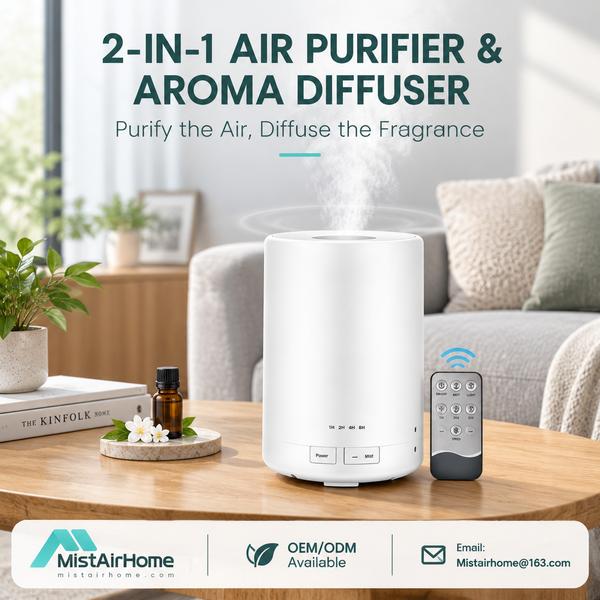
TL;DR - The Mistairhome WL-AP01D (PRO) is a True HEPA H13 plus activated carbon, ultrasonic aroma stage unit rated 132 m3/h CADR covering 189 sq ft (about 17.6 m2) at 2.5 m ceiling; aroma delivery is 480 mL at 34 mL/h for 14.1 hours per fill; operating modes are Purify only, aroma only, combined, night; it measures 26.8 dB at 1 m in operation, draws 14 W from USB-C 5V/2A mains adapter, and is documented to CE / RoHS / FCC standards for import into Macao, China. MOQ is 200 units per SKU with a 20-30 days lead time, FOB Shenzhen or EXW Longgang.
China Wanlin supplies the Essential Oil Air Purifier for Bedroom category as a direct manufacturer, not as a trading intermediary. The unit described below is one configuration out of 24 combinations (8 chassis x 3 SKU builds) that share a common filter cartridge family and a common aroma stage, so a distributor can build a coherent shelf from one supplier rather than stitching together unrelated sources. Every unit referenced on this page corresponds to a specific bill of materials held on file, so the figures below can be reproduced or independently verified at sample stage.
Full specification of WL-AP01D-PRO:
| Filtration and aroma | True HEPA H13 plus activated carbon, ultrasonic aroma stage |
| CADR | 132 m3/h |
| Room coverage | Up to 189 sq ft (about 17.6 m2) at 2.5 m ceiling |
| Filter cartridge | Two-stage composite cartridge, H13 pleated media and coconut-shell carbon |
| Cartridge service life | About 6 months at 8 h per day |
| Aroma reservoir | 480 mL |
| Mist output | 34 mL/h |
| Aroma run time | Up to 14.1 hours |
| Operating modes | Purify only, aroma only, combined, night |
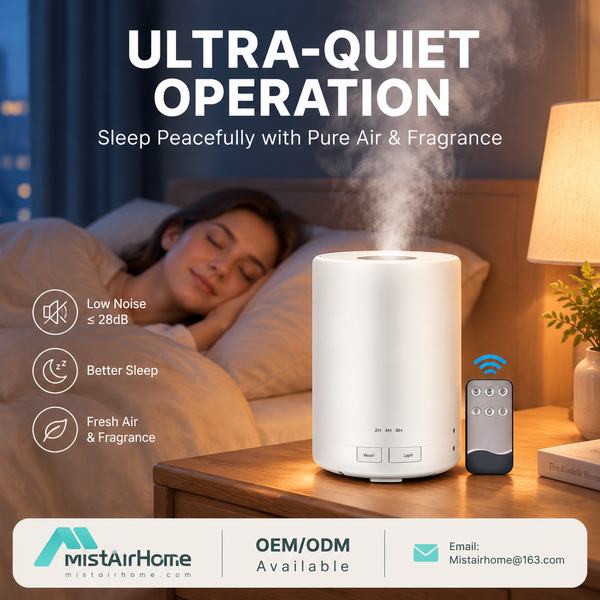
| Noise at 1 m | 26.8 dB at 1 m |
| Rated power | 14 W |
| Power input | USB-C 5V/2A mains adapter |
| Display | Touch bar with 4-step filter and water dots |
| Air quality sensor | Dust infrared scattering sensor, three-colour ring indicator |
| Connectivity | None (standalone touch control) |
| Special features | Top-fill aroma reservoir, aroma pad slot for oil without water, memory recall of last mode |
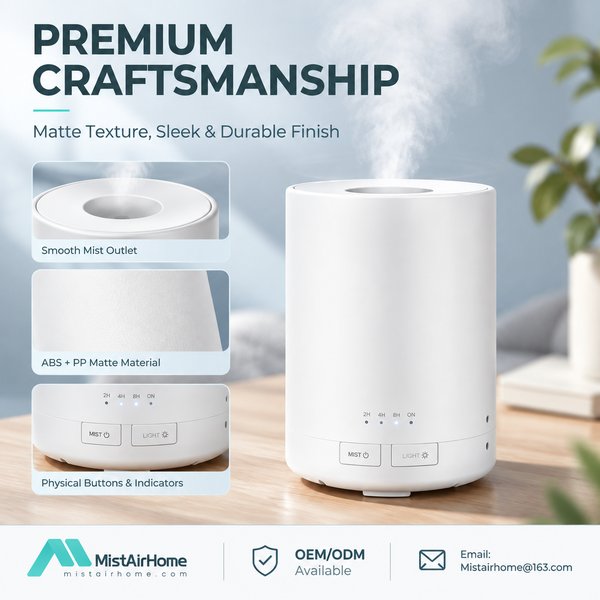
| Material | ABS + PC shell, matte finish |
| Dimensions | 18.4 x 18.4 x 26.8 cm |
| Weight | 916 g |
| Warranty | 12 months |
Shipping configuration: Pro build, + spare filter cartridge + 3 aroma pads + multilingual manual. Master carton holds 16 units. Stated lead time is 20-30 days from order confirmation and deposit. The cartridge is a repeat line item and is ordered separately from the appliance.
Demand in Macao, China is driven less by average air quality than by the number of bad days, because a single hazy afternoon is tolerated while a fourth one in a week converts into a purchase. Market entry cost is falling because small-batch first orders are now viable: a distributor can test a range without committing to full container quantities on unproven models.
For the Essential Oil Air Purifier for Bedroom segment the deciding specification is usually noise first, cartridge running cost second and CADR third, the reverse of how many first-time buyers rank them. This is why the table above states figures by model rather than by marketing tier: a buyer comparing two SKUs needs to see the measured decibel figure and the cartridge service life side by side, because those two numbers predict return rates better than any other pair.
Wanlin serves Macao, China through three programmes that suit different balance sheets. New partners start with sample evaluation then a mixed trial order. Established distributors move to scheduled container shipments with locked pricing windows. Brand owners run private-label programmes with their own artwork and manuals. In all three cases the factory documentation, including the certificates listed further down this page, references the specific model code on the order rather than a generic family certificate, which is the most common cause of customs delay in this category.
Three engineering decisions separate this platform from the commodity end of the category. The first is the air path order. On cheaper combos the misting element sits upstream or in a bypass, so scented water leaves the unit without ever passing the filter media. Here the aroma stage sits downstream of the cartridge inside the same path, which means the air is filtered first and picks up scent afterwards. The practical consequence is that the published CADR is measured with the aroma stage off, so the stated figure is never flattered by a bypass arrangement.
The second is the carbon bed. Particulate filtration and gas-phase odour control are different physical processes, and a HEPA cartridge alone does essentially nothing for cooking smell, pet odour or smoke residue. The models in this range that carry a granular carbon bed are the ones specified for odour work, and the specification table states the bed mass rather than an unspecified carbon layer, because bed mass is what determines how many months the cartridge lasts before it breaks through.
The third is acoustics. Noise at one metre on the lowest step is the figure that decides whether a unit stays switched on overnight, and it is dominated by air path geometry rather than by fan speed alone. Broadening the flow area and damping the housing lets the same air volume move at a lower velocity, and velocity is what generates most of the audible component. This is why the quietest model in the range is not the weakest one.
Every production batch is sampled for three things before release: CADR against the declared figure in a 30 m3 chamber, decibel reading at one metre in a semi-anechoic corner, and cartridge media weight against the bill of materials. Units falling outside tolerance are pulled before packing rather than after arrival, because a container of marginal units is a far more expensive problem at the destination than at the factory.
Operating requirement: Particulate load rises with occupancy while the noise ceiling is set by the nearest phone call.
How the WL-AP01D answers it: Auto mode tracks the sensor rather than running flat out, so the unit is loudest only during the actual occupancy peak. The figures below come from the same specification set shown in the table above, so the numbers quoted in this scenario and that table cannot disagree.
Deployment: Two-room flat in a 19th-century Croix-Rousse silk workshop conversion
Duration: 2025 July to August, heat wave period with street-facing windows on a cobbled slope
The flat has 3.4 m ceilings and a mezzanine sleeping platform where warm air pools. A WL-AP01D sat on the lower floor and a WL-AP02B on the mezzanine. The point that mattered was the 22 dB figure: the occupant is a light sleeper and had previously rejected a purifier outright because the unit she tried measured 41 dB. She has kept the aroma stage off in summer and on in winter, which is a usage pattern the supplier now mentions to other buyers rather than assuming daily scent use.
Deployment: Twenty-second floor apartment in a 2015 Haeundae tower
Duration: 2025 March to May, spring Asian dust episodes with windows sealed
Spring dust events here arrive as a yellow film on balconies within hours. A WL-AP05S in the main living area logged PM10 through the app during four dust episodes; the resident set the schedule to run turbo from the morning the national dust forecast issued an advisory. The measurable outcome was the balcony door track, which previously needed wiping after every episode and now did not.
Deployment: Garden flat in a 1960s Randburg property
Duration: 2025 June to August, Highveld winter with load-shedding and no municipal air quality monitoring nearby
Winter inversion traps wood and coal smoke from surrounding townships. The flat also loses power on a published schedule, which matters because a unit that forgets its setting is useless here. A WL-AP01D with memory recall resumed its previous mode automatically after each outage; across 43 outage events in the season the resident never had to restart it. That feature, not the filtration figure, is what she cites when recommending the model.
Across these deployments the pattern is consistent. Buyers who specify from measurements rather than superlatives end up with fewer returns, and the two measurements that matter are noise at one metre and cartridge service life under the buyer's own loading. Everything else, including how a unit looks in photographs, affects the first order only.
The same chassis is specified into four quite different duties, and the differences are worth stating plainly because they decide which model a buyer should stock rather than which one looks best in a listing.
| Scenario | Setting | Operating requirement |
| SC09-KITCHEN | Open-plan kitchen-diner with cooking events twice daily | Oil aerosol peaks sharply for 20 to 40 minutes then decays; continuous high speed wastes cartridge life. |
| SC02-OPENPLAN | Open-plan office floor, 30 to 60 desks, sealed facade | Particulate load rises with occupancy while the noise ceiling is set by the nearest phone call. |
| SC05-SMOKEROOM | Apartment with a smoker, or a room above a smoking neighbour | Third-hand residue on soft furnishings keeps re-releasing odour for days after the smoke itself clears. |
| SC08-DESKTOP | Single workstation or dorm desk, one spare socket or a laptop port | The unit must not compete for power or desk area, and it must travel at term break. |
Two consequences follow for a distributor. First, a range built around one chassis and three SKUs covers more duty than a range built around three unrelated models, because the accessory and cartridge line is shared. Second, the accessory is where the margin sits after the first season: cartridges, aroma pads and demineralisation cartridges repeat, while the appliance itself does not.
Working factory direct changes four things that a distributor notices. Specification is fixed at the bill of materials rather than at the catalogue, so a quoted CADR or decibel figure is the figure the container ships with, not a figure that drifts between batches. Documentation is issued per model code, which removes the generic family certificate problem that holds shipments at customs.
Third, the consumable line is controlled by the same supplier. A purifier is not a one-time sale; the cartridge is the repeat business, and buying it separately from a third party is how a range loses its margin in year two. We ship cartridges in the same container as the appliances, which is also the cheapest freight available for them.
Fourth, changes are possible without a new supplier search. Housing colour, panel insert, packaging artwork, manual language and app branding are all handled inside the existing tooling for most models in this range. Buyers who start with a standard build and move to private label in the second season do not restart the engineering conversation.
None of this removes the need for the buyer to test. We send samples on the same production specification as the bulk order, and we would rather a buyer measure a sample and find a limitation early than place a container against a claim they have not checked.
Documentation is issued against the model code on the order. The standard set covers CE / FCC / RoHS / UKCA / REACH / EMC / ErP / PSE / KC / RCM / CARB, with the ozone emission test report included because several jurisdictions require it before an air cleaner may be listed at all.
Three points matter for import planning into Macao, China. The safety report is issued to IEC 60335-1 as a household appliance, not as a piece of electronics, because that is how the product is classified at customs in most markets. The radio documentation applies only to the connected models and is issued separately, so a distributor stocking only the standalone models does not carry that requirement. And the ozone emission report belongs to the appliance, not to the cartridge, so it stays valid across cartridge revisions.
Buyers should confirm the local listing requirement before ordering, because in some markets the appliance registration is done by the importer rather than the manufacturer. We supply the test report and the technical file in a format the importer can file, and we state clearly which parts of the file are ours to issue and which parts need the importer's own entity details.
The landed cost model for this category has three lines, and only the first is obvious. The appliance is line one. The cartridge is line two, and it recurs roughly every six to twelve months per unit depending on loading. Freight is line three, and it is unusually significant here because a purifier is a bulky, low-density product that cubes out a container before it weighs out.
Cartridge planning is where first-season distributors most often get it wrong. Ordering one cartridge per unit leaves the installed base without a replacement in month seven, which is exactly when a retail buyer reviews the line. We suggest one spare cartridge per two units on the first order, then a cartridge-only shipment scheduled against the install base.
The unit specified on this page ships with pro build, + spare filter cartridge + 3 aroma pads + multilingual manual. Master carton quantity is 16 units, which is the figure that sets the freight quote. Buyers consolidating several models into one container should send the model mix before quoting, because carton quantities differ between chassis and the container plan changes accordingly.
On pricing: we quote FOB Shenzhen or EXW Longgang against a stated quantity and SKU mix. We do not quote a single unit price that silently assumes the highest-volume configuration, and we state the validity window on the proforma rather than leaving it open.
Question 1: What is the minimum order quantity for a first purifier diffuser order?
Answer: MOQ is 200 units per SKU for standard builds and 300 units for custom colour or private-label packaging. Mixed-container orders combining several models are accepted as long as each individual SKU clears its own minimum. The specification table on this page shows the exact build we ship for each SKU suffix.
Question 2: Does the aroma stage reduce the filtration performance?
Answer: Not on our platform. The aroma stage sits downstream of the filter cartridge in the same air path, so the air is filtered before it picks up scent, and the mist is generated from water that has already passed the demineralisation cartridge on humidifying models. The published CADR is measured with the aroma stage switched off, which is the conservative way to state it.
Question 3: Can the aroma reservoir be shipped empty to reduce hazmat paperwork?
Answer: Yes, and most buyers choose this. The reservoir ships dry and empty, with the aroma pads as a separate dry component, so the shipment carries no liquid and no essential oil classification. Oil is sourced or filled by the buyer in their own market under their own cosmetic or fragrance regulation.
Question 4: Which compliance files ship with a purifier diffuser order?
Answer: The standard file set is the CE technical file, RoHS and REACH declarations, an EMC test report, the ErP standby-power statement, and the IEC 60335-1 household appliance safety report. For North America we supply the CARB ozone emission test report, which several states require for listing, along with FCC documentation for the digital control section.
Question 5: Can we sell these under our own brand?
Answer: Yes. Private label covers housing colour, logo placement, retail artwork, manual language and the app branding on connected models. The tooling change is limited to the front panel insert and the packaging, so private label does not require a new mould for most models in this range.
Question 6: How long does a filter cartridge actually last in a polluted market?
Answer: It depends on loading, and we would rather state that plainly than quote a single number. The figure in the specification table assumes a moderate urban load. In a market with seasonal wood smoke or coal heating, buyers should plan on roughly half that life, and cartridge cost should be built into the landed cost model before pricing the retail unit.
Question 7: What warranty and spare parts support do you provide?
Answer: Twelve to twenty-four months depending on the model, against manufacturing defect. Spare filter cartridges, aroma pads and demineralisation cartridges are stocked as separate line items and can be ordered in the same container as the units, which is the cheapest way to buy them. We recommend first-time buyers take one spare cartridge per two units.
Question 8: How long does sampling and first production take?
Answer: Samples ship in 5 to 7 working days from an existing specification, or 15 to 20 days if a custom colour is required. First production runs in 15 to 35 days depending on SKU and quantity, measured from order confirmation and deposit, with the exact figure stated on the proforma invoice rather than left open.
Where an answer above depends on the buyer's market or loading, the honest answer is that it depends, and we would rather say so than publish a figure the buyer cannot reproduce. Buyers comparing quotes should check whether a rival's cartridge life figure states the loading assumption it was measured under.
Four kinds of partner do well with this range. Importers with existing appliance distribution take container volumes and service the retail channel. Regional distributors buy mixed pallets and cover the independent retail and hospitality channel, where the short-let and small-hotel segment is growing fastest.
Online and cross-border sellers take mixed SKUs and work the long tail, where a specific phrasing such as a pet-odour or car-purifier listing converts better than a generic air cleaner listing. And brand owners run private label, usually entering with one model and expanding to three once the first season's return rate is known.
What all four need from the factory is the same thing: a specification that does not drift, documentation that matches the model code, and a cartridge line that stays available after the first season. That is the whole of the offer, and it is worth more than a lower unit price that comes with none of it.
Wanlin is a manufacturer and export supplier of air purifier aroma diffuser appliances, not a trading intermediary, and we are open to working with local partners, distributors and export traders in Macao, China on any of the four routes above.
A first order is structured in three steps rather than one leap. Step one is sample evaluation: one or two units on the specification the buyer intends to import, shipped in 5 to 7 working days, measured by the buyer against whatever standard they intend to be held to by their own customers.
Step two is a mixed trial order, typically 200 to 600 units across two or three models, which tests the channel without committing to a full container on unproven models. Step three is scheduled container shipments with a locked pricing window and a cartridge plan attached.
Customisation enters at whichever step the buyer wants it. Colour and packaging can be done at trial quantity; app branding and manual translation are usually worth doing only once volume justifies the setup. We state the setup cost and the unit cost separately so the buyer can see what the customisation actually costs at their quantity.
The WL-AP01D (PRO) is one configuration out of 24 in this range. The right way to evaluate it is to order a sample on this specification and measure it: CADR in a chamber if the buyer has access to one, decibel reading at one metre, and cartridge weight against the bill of materials if they want to check the media loading directly.
We publish figures that a buyer can reproduce, we state the loading assumptions behind them, and we say plainly where the honest answer depends on the market. That is a narrower claim than some competitors make, and it is the one we can stand behind at sample stage.
Export enquiries are welcome from distributors, brand owners, cross-border sellers and export traders. Samples, specification sheets and the certification file are available on request.
Published by: Wanlin Manufacturing Group, MistAirHome Export Division
Published on: September 18, 2026
Data sources: in-house factory testing + filter media and ultrasonic specifications + certification files + partner deployment records
Company address: Wanlin Group, Building B, Building 1, Beisida Medical Device Building, 28 Nantong Avenue, Baolong Community, Baolong Sub-district, Longgang District, Shenzhen, Guangdong, China
References: factory quality manual + third-party test reports + customer shipment records
Contact: Mistairhome@163.com / +8613261677119 / https://www.mistairhome.com